
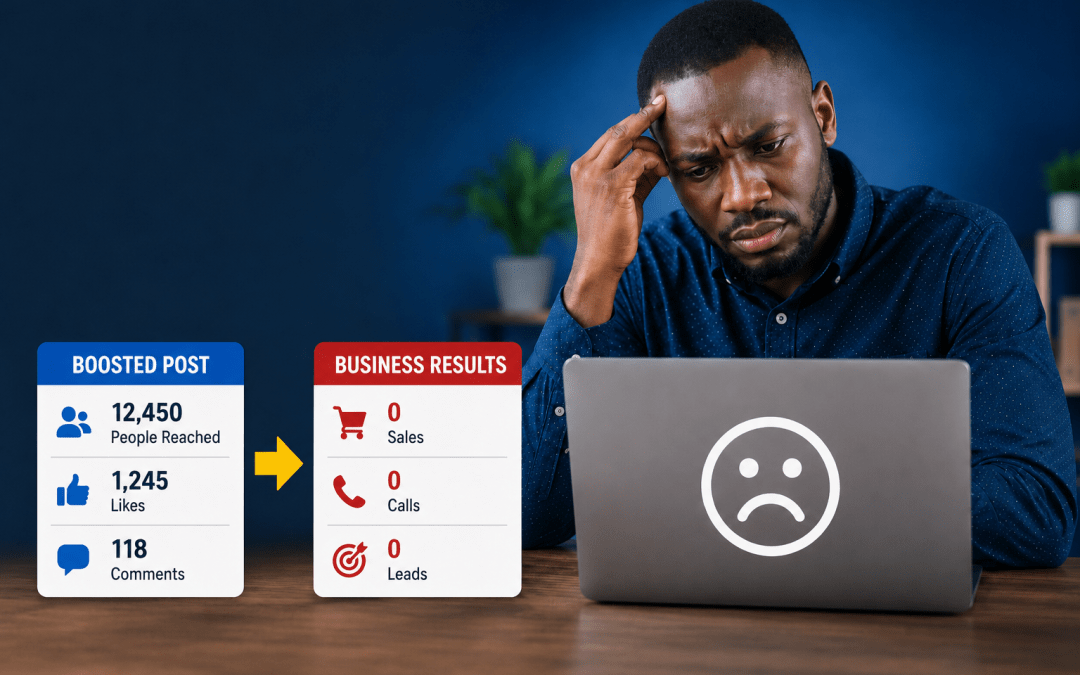
One day, you are bored with the slow, organix activity on your brand so you step it up and spend money boosting a Facebook or Instagram post. The post reaches thousands of people. It receives likes, reactions and perhaps a few comments. For a moment, the promotion appears to be working. Then the campaign ends and there’s no serious inquiry, no orders, no bookings and you are left wondering if Facebook and Instagram advertising is just a scam
This is a common experience for small businesses. The problem, however, is not always that Meta advertising does not work. In many cases, the business pays to promote a post without first building a proper advertising campaign. Boosted posts can increase visibility and engagement but rarely lead to customer acquisition
Here is why your boosted posts may be attracting attention without bringing you customers.
What Is a Boosted Post?
A boosted post is an existing Facebook or Instagram post that you pay Meta to distribute to more people. It is one of the simplest ways to advertise because you do not need to build a full campaign in Meta Ads Manager. You select a goal, audience, budget and duration directly from the post. Meta describes boosted posts as ads created from posts already published on a Facebook Page. It also distinguishes boosting from the more detailed campaign-building options available through Ads Manager.
Boosting can be useful when your goal is to:
- Increase awareness
- Reach more people
- Promote an announcement
- Gain reactions and comments
- Give an important post more visibility
- Encourage visits to your profile or page
The problem begins when a business expects a simple boost to perform the work of a complete sales campaign.
1. You Are Paying for the Wrong Result
Meta does not simply show every advertisement to random people. Its advertising system tries to find people who are likely to complete the result you selected. Meta currently organises advertising around objectives including awareness, traffic, engagement, leads, app promotion and sales. The objective helps tell the system what result the advertiser wants. When you optimise for engagement, Meta looks for people within your audience who are likely to react, comment, share or interact with content. These people may be very active on Facebook or Instagram, but that does not necessarily mean they are ready to buy.
When you optimise for leads, the system instead attempts to find people who are more likely to share their contact information or begin an inquiry. When you optimise for sales, it looks for people more likely to complete a purchase or another defined conversion. Meta explains that a performance goal tells its delivery system which result it should try to obtain as efficiently as possible. Therefore, if you paid for engagement and received engagement, the platform may have delivered exactly what you requested. It simply did not deliver what you hoped the engagement would eventually become.
2. You Boosted a Normal Post Instead of Creating an Advertisement
A social media post and an advertisement do not always have the same job. A normal post may be created to:
- Educate your followers
- Celebrate an achievement
- Share an update
- Entertain your audience
- Show company culture
- Maintain an active page
An advertisement must persuade a specific person to take a specific action, and therefore, needs a clear offer, a relevant message and a direct next step. Putting money behind a weak post does not make the message more convincing. It only exposes the weak message to more people.
3. Your Audience Is Too Broad
A common targeting approach is to select:
- Country, for example, Uganda
- Ages 18 to 65
- Men and women
- A few general interests
That may create a large audience, but a large audience is not automatically a useful audience. A broad audience may interact with your content without having any reason or ability to purchase your service. Good targeting begins with a clear understanding of the buyer; not with the list of interests available inside Meta.
4. You Are Trying to Sell to Cold Strangers Immediately
People do not open Facebook or Instagram planning to buy from an unfamiliar company. They may be checking messages, watching videos or catching up with friends and your advertisement interrupts that activity. This means the message must quickly answer three questions:
- Why should I pay attention?
- Why should I trust this business?
- Why should I act now?
Many boosted posts move directly from “We exist” to “Buy now” and that is a large jump, especially for expensive or trust-sensitive services. A person may need to see proof, understand the offer and become familiar with the business before making an inquiry. This is why effective campaigns often use different messages for different stages. One advertisement may introduce the problem. Another may explain the solution. A later advertisement may show results, testimonials or a clear offer. A single boosted post is rarely a complete customer journey.
5. Your Offer Is Not Strong Enough
Sometimes the advertisement is not the main problem, the offer is. Your message should be easy to understand and the customer should know exactly what is being offered and what they will receive. By the way, a strong offer does not always require a discount. It just needs clarity.
Your audience should quickly understand:
- What you are selling
- Who it is for
- What problem it addresses
- What is included
- What action they should take
If people cannot understand the offer within a few seconds, many will scroll past it.
6. Your Creative Attracts Attention but Not Buyers
An attractive design can generate reactions without generating interest in the product. You have surely seen these types of boosted posts. People may like the post because they agree with it or enjoy the design but that reaction does not mean they want to buy. A sales-focused advertisement should connect the creative directly to the customer’s problem and the offer being promoted. Good advertising creative should attract the right attention not merely the most attention.
7. Your Call to Action Is Too Weak
“Contact us” is technically a call to action, but it often gives the customer very little reason to act. A stronger call to action tells the person what will happen next. For example, request a quotation, book a consultation, get the full programme and so on.
Note that, the next step should also match the customer’s level of readiness. Someone discovering your business for the first time may not be prepared to “buy now.” They may, however, be willing to view prices, request more information or start a WhatsApp conversation.
8. The Destination After the Click Is Poor
Getting someone to click is only the beginning. Where do they go afterwards?
- A slow website?
- A confusing homepage?
- A WhatsApp number with no prepared response process?
- A page with no prices or useful information?
- A form that asks too many questions?
A good advertisement cannot rescue a poor customer journey. The landing page or WhatsApp conversation should continue the same promise made in the advertisement. If the advertisement promotes a particular product, the link should open that product’s sales page not a general homepage. Every unnecessary step creates another opportunity for the customer to leave.
9. You Are Measuring Likes Instead of Business Results
Likes are easy to see, which makes them feel important but a business should measure results connected to its actual objective, which may include: qualified inquiries, cost per inquiry, website visits, page views and so on. A campaign that receives 500 likes and no inquiries is less valuable than one receiving 20 likes and 3 serious leads. The most visible result is not always the most useful one. So, before spending money, decide what success means. If the goal is customer acquisition, engagement should not be treated as the final result.
10. You Stop the Campaign Too Quickly
Many small businesses boost a post for one or two days, see no immediate sales and switch it off. Others make frequent changes to the audience, budget and creative while the campaign is still running. Meta’s advertising system uses an initial learning period to understand how an ad set may deliver. Meta notes that frequent or significant changes can affect delivery, while small audiences and low budgets can contribute to limited learning. This does not mean every campaign should be left running indefinitely. It means advertising should be tested methodically. Allow enough data to determine what is working before making a decision.
11. You Expect Advertising to Fix a Weak Business Foundation
Advertising increases exposure but it does not automatically create a competitive offer, customer trust, strong branding, good service, clear prices or reliable delivery. If customers click your advertisement and find an incomplete page, inconsistent information or no evidence that the business can deliver, many will hesitate. So, before increasing the advertising budget, examine the full sales process because the problem may be happening after the advertisement has already done its job.
So, Are Boosted Posts a Waste of Money?
No. Boosted posts can be useful when the objective is simple visibility or engagement. The mistake is expecting every boost to produce immediate customers. Meta itself distinguishes boosted posts from campaigns created through Ads Manager, where advertisers have more control over objectives, targeting, placements, creative and campaign structure.
Boosting is a promotional tool. It is not a complete marketing strategy.
Learn How Meta Ads Actually Work
Many business owners boost posts because the boost button is easy to find. However, understanding these basics can be the difference between paying for attention and paying for business results.
The Meta Ads for Lead Generation Course is designed for business owners, marketers and professionals who want to move beyond random boosted posts and build more deliberate advertising campaigns. The course focuses on practical lead-generation campaigns rather than complicated theory. It helps learners understand campaign structure, targeting, advertising messages, lead handling and the decisions that affect performance.
Explore the Meta Ads for Lead Generation Course.
Your boosted posts may not be failing because Facebook and Instagram advertising no longer works but because the campaign was built to receive attention instead of customers. The Boost button makes advertising easy to start, but it does not remove the need for strategy.
Before promoting your next post, ask:
- Who exactly is this for?
- What result do I want?
- Why should someone care?
- What am I asking them to do?
- What happens after they click?
- How will I measure success?
When these questions are answered properly, you stop spending money simply to make posts more visible. You begin building advertising campaigns that have a realistic chance of generating inquiries, sales and customers.